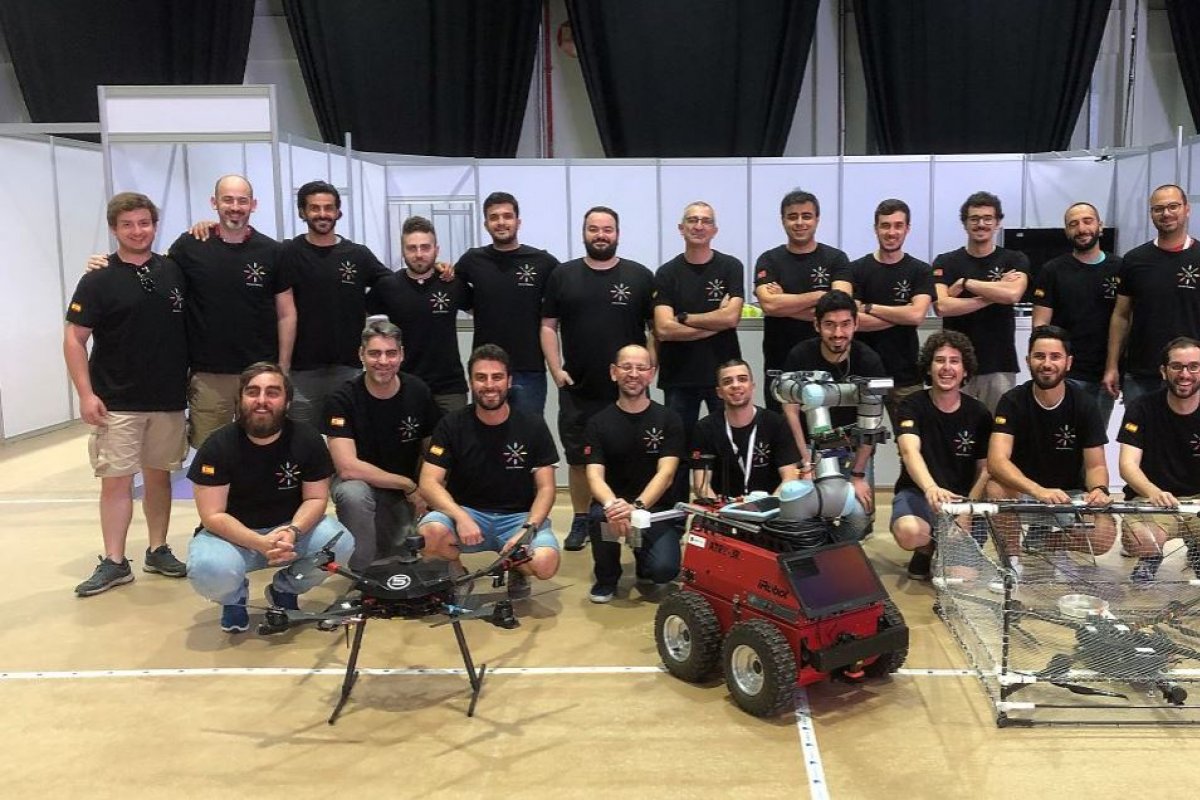
U. Seville, CATEC and IST engaged in this competition to develop together technologies which are also paramount for DURABLE, namely the use of mobile manipulator UGVs (Unmanned Ground Vehicle), UAVs (Unmanned Aerial Vehicle) and their joint performance of cooperative tasks.
ISR team participated in the Mohamed bin Zayed International Robotics Challenge (MBZIRC 2020). The team of Iberian Robotics – composed of ISR/Técnico, the University of Seville and FADA-CATEC (Advanced Center for Aerospace Technologies) – won the victory in one of the MBZIRC2020’s challenges. The team also won an honourable 4th place in the Grand Challenge.
The Iberian Robotics won Challenge 3 of the competition: a team of UAVs and a UGV will collaborate to autonomously extinguish a series of simulated fires in an urban high rise building firefighting scenario. Challenge 3 is motivated by the use of robots for urban firefighting, and requires the team of robots to collaborate to autonomously carry out a series of urban firefighting related tasks in an outdoor-indoor environment. “UAVs can extinguish indoor fires on the upper floors as well as fires on the building facades and on the floor near it. The UGV can extinguish one of two fires inside the building on the ground floor, but also one outside. Outdoor fires can be extinguished using a blanket carried by an AUV or an UGV ”, explains professor Pedro Lima, project mentor and the coordinator of ISR’s Intelligent Robots and Systems group.
After this victory, the team competed in the Grand Challenge, a separate event that requires a team of robots (UAVs and UGVs) to compete in a triathlon type event that combines Challenges 1, 2 and 3. The Iberian Robotics was once again the most consistent team, “and the only one that scored points in the 3 challenges”, says professor Pedro Lima. “It is an excellent classification, among 17 teams. Universities such as CMU [Carnegie Mellon University], ETH Zürich, DTU [Technical University of Denmark] or prestigious research centers, such as KAIST [Korea Advanced Institute of Science and Technology] or IISc [Indian Institute of Science] stayed behind”, stresses professor Pedro Lima.
The team members were very happy with the excellent results, although “some technical problems, resulting from the difficulty of the challenges and tasks, and the lack of a longer access to the operations site”, shares the Técnico professor.